How to Choose an Incense Burner Manufacturer for Your Brand

2024-11-04
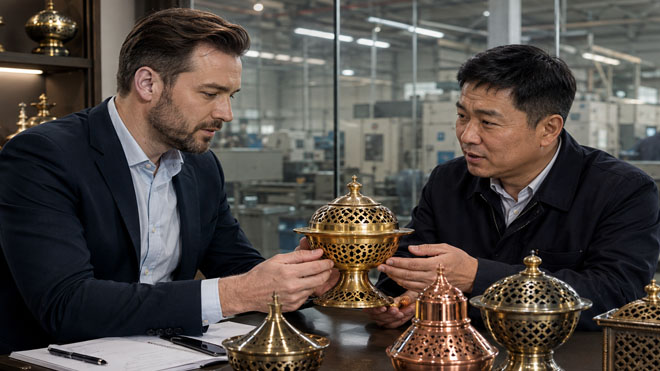
Choosing the right incense burner manufacturer involves more than comparing prices. A suitable manufacturing partner must understand product design, metal processing, surface finishing, quality control, packaging, and the expectations of your target market.
This is especially important for brands, wholesalers, importers, hotels, and gift companies selling Middle Eastern incense burners. These products often combine functional requirements with detailed decoration, polished metal surfaces, and culturally specific designs.
Before placing an order, buyers should evaluate whether the supplier can consistently turn an idea, drawing, or physical sample into a reliable finished product.
Start with the Manufacturer’s Product Experience
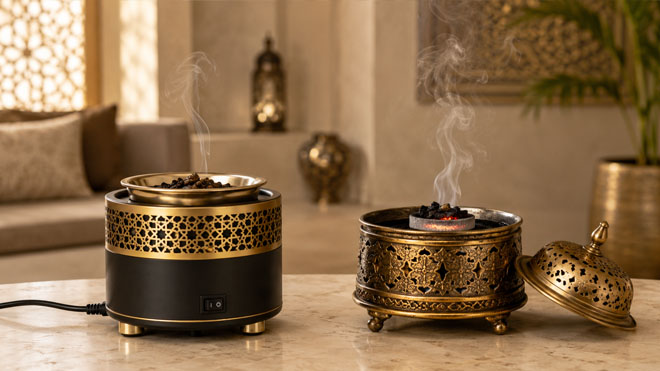
A manufacturer with relevant product experience will understand the practical requirements of charcoal incense burners, electric burners, decorative burner sets, incense jars, bowls, and accessories.
For example, charcoal incense burners must be designed with appropriate heat resistance, airflow, stability, and internal bowl construction. Decorative details should not interfere with assembly or normal use.
Ask the supplier whether they have experience manufacturing products for bakhoor, oud, charcoal incense, hotels, retail brands, and gift markets. A manufacturer familiar with these applications is more likely to identify potential design problems before tooling or mass production begins.
You can review Huadi’s current range of incense burners to understand the available product categories and structures.
Evaluate OEM and Product Development Capabilities
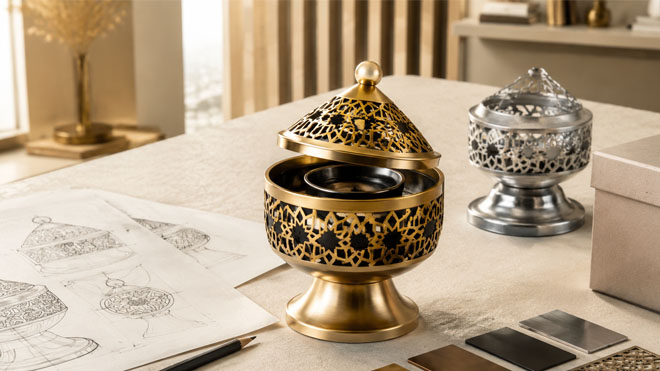
A capable custom incense burner manufacturer should be able to work with different types of project information, including:
- 2D drawings
- 3D models
- Physical samples
- Reference images
- Basic sketches
- Initial product concepts
The manufacturer should review dimensions, structure, materials, assembly, finishing, tooling, and production feasibility before providing a final quotation.
If you only have a reference image, ask whether the supplier can help develop a manufacturable structure. If you already have complete drawings, request a design-for-manufacturing review to identify risks related to wall thickness, heat exposure, component fitting, polishing, plating, and assembly.
A clear OEM development process reduces misunderstandings and helps prevent costly changes after tooling begins.
Compare Available Materials
Material selection affects appearance, weight, cost, durability, heat resistance, and finishing options. A professional incense burner supplier should explain the advantages and limitations of each material instead of simply recommending the cheapest option.
| Material | Main Advantages | Common Applications |
|---|---|---|
| Aluminum alloy | Lightweight and easy to process | Decorative burners and covers |
| Zinc alloy | Suitable for detailed casting | Ornate components and luxury designs |
| Stainless steel | Durable and corrosion resistant | Modern burners, bowls, and trays |
| Iron | Strong and cost-effective | Structural parts and traditional designs |
| Brass | Premium appearance and weight | High-end collections and gift products |
| Copper | Distinctive color and decorative value | Premium burners and accessories |
The final choice should be based on the product structure, order quantity, target price, finishing requirements, and intended application.
Review Surface Finishing Capabilities
The appearance of an incense burner often plays a major role in its market value. Uneven plating, visible polishing marks, inconsistent color, or scratches can make an otherwise functional product difficult to sell.
Ask the manufacturer about available finishing processes, such as:
- Polishing
- Brushing
- Electroplating
- Painting
- Powder coating
- Anodizing
- Antique finishes
- Gold, silver, copper, or rose-gold effects
The supplier should use approved samples or finish standards to control color, gloss, texture, and appearance during production. For branded collections, it is advisable to approve a physical finish sample before bulk production.
Check the Sampling and Approval Process
Samples allow buyers to check the product before committing to mass production. Depending on the project, the sample may be a handmade prototype, pre-production sample, tooling sample, or finished production sample.
A complete sample review should cover:
- Overall dimensions
- Product proportions
- Metal thickness
- Bowl and ventilation structure
- Component fitting
- Surface finish
- Color consistency
- Logo position
- Assembly
- Packaging fit
Do not approve a sample based only on photographs when appearance, weight, color, or surface texture is important. A physical sample provides a more reliable basis for production approval.
Understand Quality Control Procedures
Quality control should cover the entire production process rather than only the finished product.
A reliable manufacturer normally checks incoming materials, casting or metal forming, machining, dimensions, polishing, plating, painting, assembly, appearance, and packaging.
Ask how the supplier controls:
- Critical dimensions
- Component compatibility
- Sharp edges and burrs
- Surface scratches
- Plating and color consistency
- Burner stability
- Bowl positioning
- Decorative details
- Packaging protection
The inspection criteria should be agreed upon before production. For custom products, drawings, approved samples, finish references, and packaging requirements should form part of the quality standard.
Confirm Production Capacity and Lead Time
Production capacity is important, but buyers should also consider how the manufacturer schedules orders and manages different processes.
Huadi Hardware’s monthly production capacity can reach approximately one million units, depending on product complexity, surface finishing, assembly, and order scheduling.
Actual lead time may be affected by:
- Tooling requirements
- Material availability
- Product complexity
- Plating or painting processes
- Packaging development
- Order quantity
- Sample approval time
Instead of asking only for the fastest delivery date, request a clear schedule covering design review, sampling, tooling, production, inspection, packaging, and shipment.
Discuss Packaging Before Production
Packaging should not be treated as a final-minute decision. Incense burners often contain polished or plated surfaces that can be scratched during handling and transportation.
Ask whether the manufacturer can provide:
- Individual protective bags
- Foam or molded inserts
- Color boxes
- Gift boxes
- Product labels
- Barcode labels
- Instruction cards
- Master cartons
- Customized branded packaging
Packaging should protect the product while also matching its retail position. Premium incense burner sets may require coordinated packaging for the burner, jar, tongs, bowls, and other accessories.
Assess Communication and Responsiveness
Good communication is one of the clearest indicators of a dependable manufacturing partner.
The supplier should ask detailed questions about your design, quantity, market, material, finish, packaging, and delivery expectations. A quotation prepared without confirming these details may not accurately reflect the final product.
Pay attention to whether the manufacturer:
- Responds clearly and consistently
- Identifies missing information
- Explains technical limitations
- Provides realistic production schedules
- Records approved changes
- Confirms specifications before production
A lower quotation is not always a better offer if important materials, finishing processes, tooling, packaging, or inspection requirements have been omitted.
Use a Supplier Evaluation Checklist
Before choosing an incense burner manufacturer, compare suppliers using the same criteria.
| Evaluation Area | Questions to Ask |
| Product experience | Have they manufactured similar incense burners? |
| OEM capability | Can they work from drawings, samples, or ideas? |
| Materials | Can they recommend suitable metals? |
| Finishing | Can they control color, plating, and polishing? |
| Sampling | Is a physical sample available before production? |
| Quality control | Which production stages are inspected? |
| Capacity | Can they support repeat and bulk orders? |
| Packaging | Can packaging be customized and tested? |
| Communication | Are specifications and changes documented? |
Build a Long-Term Manufacturing Partnership
The right manufacturer should support more than one purchase order. A long-term partner can help you improve existing products, develop new collections, control repeat-order consistency, and respond to changes in your market.
Dongguan Huadi Hardware Products Co., Ltd. specializes in Middle Eastern incense burners, burner accessories, incense jars, bowls, tongs, and custom metal components. We support projects from design evaluation and prototype development to finishing, assembly, packaging, and bulk production.
Explore our products, learn more about Huadi, or contact our team to discuss your custom project.
Frequently Asked Questions
What information should I provide for an incense burner quotation?
Provide a drawing, sample, reference image, dimensions, preferred material, surface finish, estimated order quantity, logo requirements, packaging style, and destination market. More complete information helps the manufacturer prepare a more accurate quotation.
Can an incense burner manufacturer develop a product from a reference image?
Yes. An experienced manufacturer can evaluate the reference image and propose a practical structure, material, manufacturing process, and finish. A prototype should be approved before mass production.
What is the typical MOQ for custom incense burners?
MOQ depends on the product design, material, tooling, finishing process, and packaging. Standard products may support lower quantities, while fully customized designs usually require a project-specific MOQ.
Should I request a sample before placing a bulk order?
Yes. A physical sample allows you to check dimensions, appearance, finish, assembly, function, logo placement, and packaging before mass production begins.
Can incense burners and accessories be packaged as a complete set?
Yes. Burners, incense jars, bowls, tongs, charcoal holders, and other accessories can be coordinated into retail or gift sets with customized inserts, boxes, labels, and branding.
Start Your Custom Incense Burner Project
Looking for an incense burner manufacturer for your brand, wholesale business, hotel collection, or gift program?
Send us your drawing, sample, reference image, quantity, material, finish, and packaging requirements. Our team will review your project and recommend a suitable OEM manufacturing solution.
NEXT