
Custom incense burners allow brands, wholesalers, and distributors to offer products that better match their customers’ tastes. However, customization involves more than adding a logo. The burner’s material, structure, decoration, heating method, packaging, and safety all affect the final product.
A clear development plan can help you control costs, reduce revisions, and move from the initial concept to mass production more efficiently. This guide explains how to customize incense burners and what information manufacturers need before beginning a project.
Define Your Target Market First
Before discussing colors or decorative patterns, identify where and how the incense burner will be sold. A product designed for a Middle Eastern gift shop may look very different from one developed for a modern home-fragrance brand.
Important questions include:
- Which country or region is the product intended for?
- Will it be used with bakhoor, resin, incense cones, or charcoal?
- Is it intended for homes, hotels, religious settings, or gift shops?
- What retail price range are you targeting?
- Will the product be positioned as practical, decorative, or luxurious?
- Do you need wholesale packaging or individual retail boxes?
This information helps the manufacturer recommend a suitable structure, production process, and material instead of simply copying the appearance of an existing product.
Choose the Incense Burner Type
The heating method is one of the first decisions in a custom project. It affects the burner’s internal structure, material requirements, and user experience.
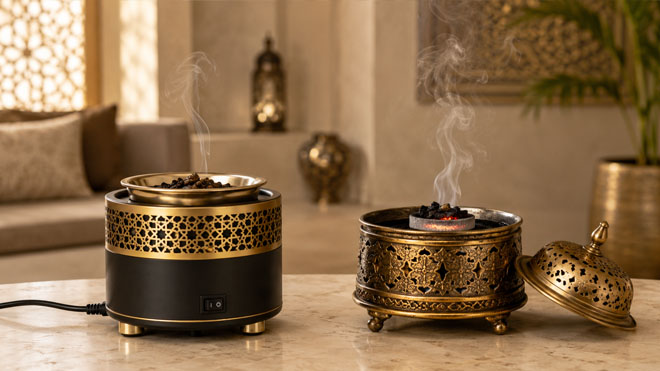
Charcoal incense burners
Traditional charcoal burners are widely used for bakhoor and aromatic wood. They usually require a heat-resistant bowl, charcoal holder, or removable inner cup. Ventilation openings must be positioned carefully to support burning while helping manage heat.
Electric incense burners
Electric burners provide a more convenient heating method and eliminate the need to handle charcoal. Their development may involve heating components, wiring, switches, plugs, temperature control, and electrical safety requirements.
Cone and stick incense holders
These designs may use trays, ash-catching surfaces, holes, or removable components. They are generally structurally simpler but still require stable placement and easy cleaning.
Choosing the type early prevents major structural changes later in the project.
Select the Right Material
Material selection affects durability, weight, appearance, heat resistance, and production cost. Metal incense burners can be produced from iron, stainless steel, aluminum, brass, zinc alloy, or combinations of several materials.
Common considerations include:
- Iron: Suitable for many decorative structures and surface finishes.
- Stainless steel: Offers good corrosion resistance and a clean appearance.
- Aluminum: Lightweight and suitable for selected forming or casting processes.
- Brass: Provides a traditional and premium visual effect.
- Zinc alloy: Useful for detailed decorative components and complex shapes.
Some designs combine a decorative outer shell with a separate heat-resistant inner container. This approach can improve usability while preserving the intended appearance.
The manufacturer should evaluate material thickness, heat exposure, structural strength, and the selected finishing process before confirming the design.
Customize the Shape and Structure
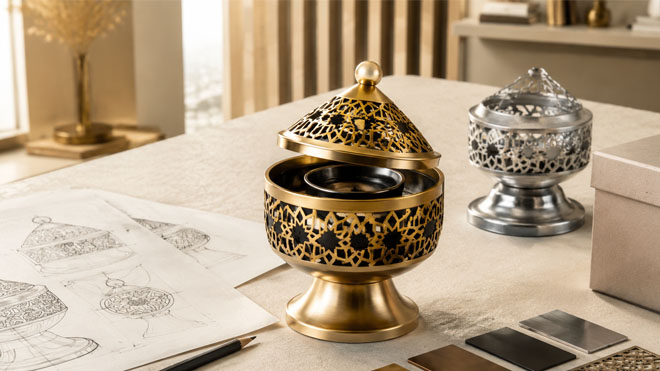
A custom incense burner can be developed from a sketch, reference sample, 2D drawing, or 3D model. The structure should balance aesthetics with manufacturability.
Customizable elements may include:
- Overall shape and dimensions
- Lid design
- Handle position
- Base and supporting feet
- Ventilation patterns
- Inner charcoal holder
- Removable ash tray
- Decorative metal panels
- Carrying or hanging components
During the design review, the manufacturer may recommend changing sharp corners, narrow openings, weak joints, or difficult-to-form decorative details. These adjustments help reduce production problems without changing the overall design concept.
Develop Decorative Patterns
Arabic geometric patterns, floral motifs, latticework, and modern minimalist openings are commonly used on incense burners. Depending on the material and production volume, patterns may be created through laser cutting, stamping, punching, engraving, casting, or metal forming.
Pattern development should consider more than appearance. Openings can also affect ventilation, light effects, heat distribution, and structural strength.
Very fine patterns may look attractive in a digital rendering but can be difficult to manufacture consistently. A design-for-manufacturing review helps determine the appropriate line width, spacing, and production method.
Choose Colors and Surface Finishes
Surface finishing gives the incense burner its final visual identity while helping protect the underlying metal.
Available options may include:
- Powder coating
- Spray painting
- Polishing
- Brushing
- Electroplating
- Antique-style finishing
- Metallic gold, silver, bronze, or copper effects
- Matte or glossy surfaces
Color samples should be confirmed under suitable lighting because metallic finishes may appear different in photographs and physical products. For a new project, requesting a finished sample is more reliable than approving the color from a screen alone.
If several parts use different materials, confirm that their colors and surface textures remain visually consistent after assembly.
Add Your Logo and Brand Identity
A logo can be applied to the incense burner, packaging, or both. The appropriate method depends on the product material, surface finish, logo size, and required durability.
Common branding options include:
- Laser engraving
- Metal stamping
- Screen printing
- Embossed or debossed logos
- Metal nameplates
- Custom tags
- Branded packaging
Logo placement should not interfere with ventilation openings, handles, or decorative patterns. A subtle engraved logo may suit a premium product, while a prominent printed mark may work better for promotional or retail collections.
Plan the Packaging
Packaging protects the incense burner and communicates its value at the point of sale. Metal products may have protruding parts, delicate finishes, or removable accessories that require secure internal support.
Custom packaging options can include:
- Printed color boxes
- Kraft boxes
- Gift boxes
- Foam or molded inserts
- Product instructions
- Barcode labels
- Shipping cartons
- Private-label artwork
Before approving packaging, check the product orientation, internal movement, surface protection, drop resistance, and carton quantity. Packaging dimensions also influence shipping volume, so oversized boxes can unnecessarily increase logistics costs.
Review and Approve the Sample
Sampling is a critical stage in custom incense burner development. A sample allows the buyer to review the product before committing to mass production.
Inspect the following points:
- Dimensions and overall proportions
- Product stability
- Lid and removable-part fit
- Pattern accuracy
- Surface color and finish
- Welds, joints, and edges
- Logo position
- Ease of cleaning
- Heat-related design
- Packaging fit and protection
Test the sample under its intended operating conditions. If charcoal will be used, evaluate heat exposure and ventilation in an appropriate environment. Any changes should be documented clearly before the manufacturer prepares the final approved sample.
Confirm Mass Production Requirements
Once the sample is approved, confirm the commercial and production details in writing. These typically include:
- Final drawings and specifications
- Approved materials
- Color and finish references
- Logo files and placement
- Order quantity
- Packaging requirements
- Quality standards
- Inspection method
- Production schedule
- Shipping terms
The approved sample and technical documents should serve as references for mass-production inspection. This reduces misunderstandings when several colors or designs are included in the same order.
Work with an Experienced Manufacturer
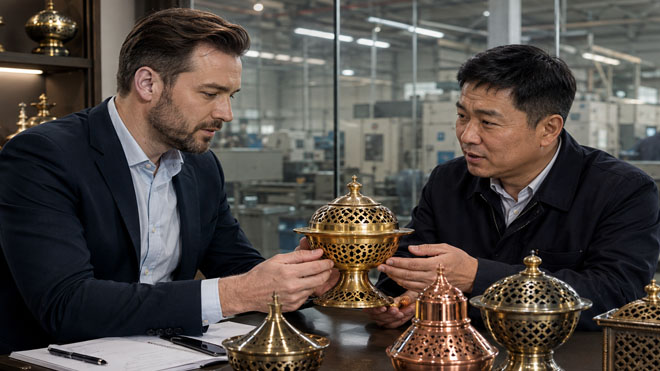
A reliable incense burner manufacturer should do more than produce the shape shown in a drawing. The supplier should evaluate material selection, manufacturing feasibility, surface treatment, assembly, packaging, and quality control.
Dongguan Huadi Hardware Products Co., Ltd. supports custom metal incense burner projects from concept development and sampling to production and packaging. Buyers can provide drawings, product samples, design ideas, or market requirements for evaluation.
Clear communication during the early stages helps create a product that is attractive, practical, manufacturable, and suitable for the intended market.
Frequently Asked Questions
What information is needed to customize an incense burner?
Provide the intended burner type, dimensions, material preference, target market, reference images, logo file, color, quantity, and packaging requirements. A physical sample or 3D drawing can make the evaluation more accurate.
Can I customize an incense burner without a finished drawing?
Yes. You can begin with a sketch, reference image, existing sample, or basic product idea. The manufacturer can review the concept and advise what technical information is required for development.
Can different colors and finishes be produced?
Yes, depending on the material and order requirements. Common options include painting, powder coating, polishing, electroplating, and antique-style finishes. Physical finish samples should be approved before production.
Where can a custom logo be added?
Logos can normally be added to the burner body, base, metal tag, packaging, or instruction sheet. The best location and application method depend on the product structure and surface finish.
Why is a prototype necessary before mass production?
A prototype helps verify dimensions, appearance, assembly, stability, surface finishing, branding, and packaging. It also allows design problems to be corrected before a larger quantity is produced.
How long does a custom incense burner project take?
The timeline depends on design complexity, tooling requirements, materials, surface treatment, sample revisions, and order quantity. A manufacturer can provide a more accurate schedule after reviewing the complete project brief.